
Dent Leon

All-on-4 vs All-on-6: Which Is Right for You?

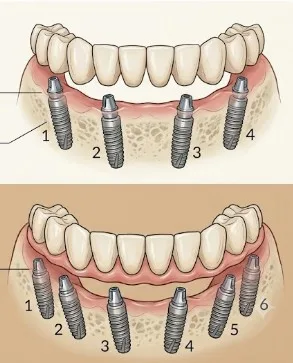
The choice between All-on-4 and All-on-6 is decided by your CT scan, not your budget. All-on-4 uses four implants to support a fixed full arch of teeth and is the right answer for most patients with standard bone volume. All-on-6 uses six implants and is the better answer when you have enough bone to place them, when your bite force is high, or when the jaw being restored is the lower one, which absorbs more load. The extra two implants in All-on-6 distribute chewing force across more anchor points and provide redundancy, but they require more available bone and cost roughly £1,000 more per arch. Neither is universally superior. A
The Choice Is Clinical, Not Financial

The most common mistake patients make is treating this as a budget decision, in which All-on-6 is the premium version and All-on-4 is the economy version. That framing is wrong and it leads people to the wrong procedure.

Both techniques deliver the same visible result: a full, fixed arch of teeth anchored to implants, replacing an entire upper or lower set. The difference is structural. All-on-4 places four implants, typically with the two rear implants angled to make use of available bone and avoid anatomical obstacles. All-on-6 places six, spreading the load of chewing across more anchor points. More implants is not automatically better, in the same way that more bolts are not automatically better than fewer if the structure is already sound. What matters is whether your particular jaw needs the extra two, and whether it has the bone to receive them. A good clinic recommends the procedure your anatomy indicates, not the one with the higher invoice, which is one of the specific things you should test a clinic on using the 12 point clinic checklist.

At Dent Leon we place both at our İzmir clinics, Güzelbahçe and Bayraklı, and the recommendation you receive follows your CT scan. Here is how that recommendation is actually reached.

All-on-4 vs All-on-6 Compared Side by Side

FactorAll-on-4All-on-6
Implants per arch46
Bone volume requiredWorks with moderate bone loss
Angled rear implants use available bone
Needs more bone, especially at the back
Load distributionAcross 4 pointsAcross 6 points, more even
Suited to high bite forceAdequate for mostBetter for heavy chewers & grinders
Upper vs lower jawCommon for upper archOften preferred for lower arch load
Redundancy if one implant failsLower marginHigher, more spare anchorage
Likelihood of needing graftingOften avoids itMore likely to require it
Surgery complexityLowerHigher
Cost per arch at Dent Leon£3,500 – £5,500£4,500 – £6,500
Best suited toMost patients with standard bone and normal biteStrong bone, heavy bite, or lower arch restoration

Prices valid for 2026 at Dent Leon Güzelbahçe & Bayraklı, İzmir, Turkey. Final recommendation and cost confirmed after CT scan review. Swipe to see all columns on mobile.

The two rows that most often decide the recommendation are bone volume required and suited to high bite force. Everything else tends to follow from those two. If your scan shows you have the bone and your history suggests a heavy bite, All-on-6 earns its extra cost. If your posterior bone is limited, All-on-4 is not a compromise, it is the technique specifically designed for that situation.

When All-on-4 Is the Right Choice

All-on-4 is the more frequently recommended of the two, and for good clinical reasons rather than cost ones. It is the right procedure when the following describe you.

  • You have moderate bone loss, particularly at the back of the jaw. All-on-4’s angled rear implants are designed precisely to anchor into the bone that remains, which is why the technique so often avoids the need for grafting. If your scan shows reduced posterior bone, this is frequently the deciding factor.
  • Your bite force is within the normal range. If you are not a heavy grinder and do not have an unusually powerful bite, four well placed implants distribute your chewing load perfectly adequately.
  • You want to avoid additional procedures. Fewer implants and a lower likelihood of grafting mean a simpler surgery and, often, a more predictable recovery.
  • You are restoring an upper arch of standard anatomy. The upper jaw absorbs less load than the lower, which makes four implants sufficient for a great many upper arch cases.
  • Cost matters and your anatomy supports it. This is the one place budget legitimately enters the decision: if your scan shows All-on-4 will serve you as well as All-on-6, there is no reason to pay for two implants you do not need.

If most of these describe you, All-on-4 is very likely what your treatment plan will recommend. The full procedure, timeline and what is included is set out on our All-on-4 in Turkey page.

When All-on-6 Is Worth the Extra Two Implants

All-on-6 is the better choice in a narrower but important set of circumstances. The extra two implants earn their cost when the following apply.

  • You have sufficient bone to place six implants. This is the precondition. Without adequate bone, All-on-6 becomes possible only after bone grafting or a sinus lift, which adds cost and time, and at that point the calculation changes.
  • You have a heavy bite or grind your teeth. Bruxism and high bite force put more stress on the arch, and spreading that stress across six anchor points rather than four reduces the load on each implant.
  • You are restoring the lower arch. The lower jaw generates and absorbs greater chewing force than the upper, and many clinicians prefer the additional support of six implants there.
  • You value redundancy. With six implants, the failure of a single one leaves more remaining anchorage than it would with four. For some patients that margin of safety is worth the extra cost on its own.

If several of these describe you, and your scan confirms the bone is there, All-on-6 is a sound investment rather than an upsell. Details are on our All-on-6 in Turkey page.

How Dent Leon Decides Which One to Recommend

The recommendation is not a matter of preference or of steering you toward the higher invoice. It follows a defined sequence.

It begins with a three dimensional CT scan taken at our İzmir clinic, which shows exactly how much bone you have and where. That scan answers the first and most decisive question: is there enough bone at the back of the jaw to place six implants without grafting? If the answer is no, the realistic options become All-on-4, or All-on-6 preceded by grafting, and we set out both with their true costs rather than hiding the grafting until you arrive. Alongside the scan we assess the jaw being treated, upper or lower, and your bite, including any history of grinding. Those three inputs, bone, jaw position and bite force, produce the recommendation.

What we will not do is quote All-on-6 as a default to raise the price, or quote All-on-4 to win the booking and then upgrade you on the day. The recommendation and the itemised cost, including any grafting your scan shows you need, are confirmed in writing before you book flights. You can see how each option is priced on our dental implant cost page, and you can start the assessment with a free virtual inspection that produces a written plan.

If you are still deciding between a fixed full arch and other approaches entirely, our comparison of dental implants versus bridges versus dentures is the better starting point.

What This Decision Cannot Be Made Without

There is one honest limit to this page, and it is worth stating clearly.

You cannot finalise the All-on-4 versus All-on-6 decision from an article, from a price list, or from a photograph of your teeth. Both procedures are driven by bone volume, and bone volume is invisible until it is imaged. Any clinic that commits you to one or the other before seeing a CT scan is guessing, and a clinic that quotes All-on-6 without confirming you have the bone to support it may be planning to add grafting costs after you arrive, or may simply not have checked. Use this page to understand the reasoning, then let the scan make the decision.

To get that decision made properly, send your details through a free virtual inspection, or call +44 7445 376130 and we will walk you through what your case is likely to need before you commit to anything.

FAQ's about Both Operation

What is the difference between All-on-4 and All-on-6?

Both replace a full arch of teeth with a fixed set anchored to implants. All-on-4 uses four implants and All-on-6 uses six. The additional two implants in All-on-6 distribute chewing force across more anchor points and provide extra redundancy, but they require more available bone and cost roughly £1,000 more per arch. The right choice depends on your bone volume, bite force and which jaw is being restored.

Not universally. All-on-6 offers more even load distribution and more redundancy, which benefits patients with strong bone, a heavy bite, or a lower arch restoration. But if your bone volume is limited, All-on-4 is specifically designed to work with the bone you have and often avoids grafting. More implants is only better when your anatomy needs them.

The decision is made from a three dimensional CT scan, which shows how much bone you have and where. The scan, together with an assessment of which jaw is being treated and your bite force, determines the recommendation. It cannot be reliably decided from photographs or a price list alone.

Because it uses two additional implants, which adds material and surgical cost. At Dent Leon in İzmir, All-on-4 costs £3,500 to £5,500 per arch and All-on-6 costs £4,500 to £6,500 per arch. If your scan shows grafting is needed to place six implants, that is quoted separately and confirmed before you travel.

No. All-on-4 is a well established technique with strong long term outcomes, not a budget version of All-on-6. For a patient with standard bone and a normal bite, four correctly placed implants provide entirely adequate support. It is the right procedure for a large proportion of full arch cases, chosen on clinical grounds rather than cost.

The lower jaw generates greater chewing force than the upper, so many clinicians prefer the additional support of All-on-6 there when the bone allows it. The upper jaw absorbs less load, which makes All-on-4 sufficient for many upper arch cases. Your own scan and bite assessment confirm the choice.